
Re-Root Canal Treatment in Whitefield —
Your Previously Treated Tooth Deserves a Second Chance
You already went through root canal once. The pain came back — and so did the doubt. Was the first treatment done right? At Smile Stories, we don’t judge the past. We find what was missed, fix what was sealed improperly, and give your tooth a genuinely second chance before extraction becomes the only option left.
Rotary Endodontics
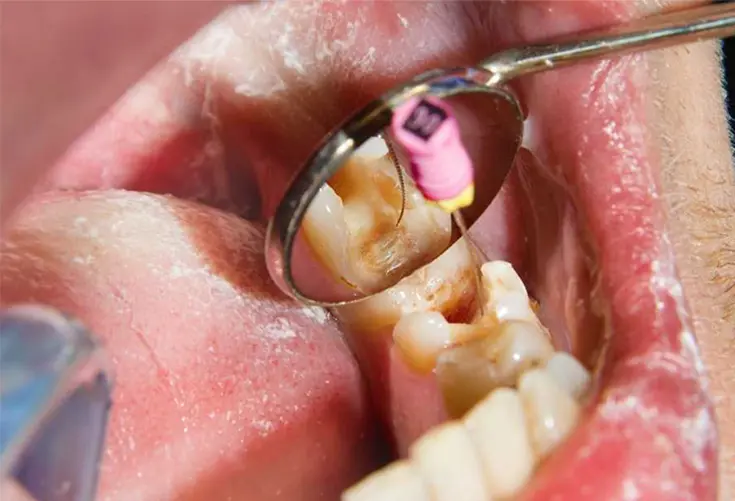
Re-root canal treatment (retreatment) is an endodontic procedure performed on a tooth that has already undergone primary RCT but developed reinfection or persistent symptoms. The procedure involves removing previous filling material (gutta-percha), locating missed or inadequately treated canals, re-cleaning with advanced irrigation protocols, and re-sealing the root canal system. At Smile Stories in Whitefield, Bangalore, Dr. Smriti Bharti uses rotary retreatment files and magnification to achieve higher success rates in complex retreatment cases.
When You Need Re-Root Canal Treatment
Don’t let a failing root canal lead to an extraction. Recognise the signs and book a diagnostic X-ray today.
Pain Returned Months or Years After First RCT
A dull ache, biting sensitivity, or gum swelling near a previously treated tooth is the most common sign that the original RCT has failed and bacteria have re-colonised the canals.
Pus or Sinus Tract Near the Treated Tooth
A pimple-like bump on the gum that periodically drains pus indicates a chronic periapical abscess — the infection is active and won’t resolve without retreatment.
X-Ray Shows Widening Periapical Radiolucency
Your dentist spotted a dark shadow at the root tip on X-ray — this radiolucency indicates bone destruction from ongoing infection that the original treatment didn’t eliminate.
Previous Dentist Missed a Canal
Molar teeth commonly have hidden accessory canals. If the original treatment missed one, bacteria remain sealed inside, causing persistent infection despite treatment.
Old Crown Leaking or Decay Under Crown
A poorly fitting or old crown can allow saliva and bacteria to re-enter the sealed canal system through microleakage — reinfecting a tooth that was previously healthy.
Told Extraction Is the Only Option
Many teeth labelled ‘hopeless’ by one provider can be saved with proper retreatment technique. A second opinion before extraction could save you from an implant procedure.
How We Perform Re-Root Canal Treatment
Seven precise steps. Advanced instruments. Honest at every checkpoint.
Re-Assessment & Advanced Imaging
We take fresh periapical X-rays, compare with old treatment records, and evaluate the root anatomy for missed canals, short fills, or ledges from previous treatment.
Crown/Post Removal
The existing crown and any post/core build-up are carefully removed to access the old root canal filling material without damaging the remaining tooth structure.
Gutta-Percha Removal
Using retreatment rotary files and solvents, we completely remove the old filling material from every canal to expose the original canal walls for thorough cleaning.
Missed Canal Detection
Under magnification and with careful tactile exploration, we locate any missed canals — the most common reason for primary RCT failure in molars.
Advanced Disinfection Protocol
Canals are re-shaped, irrigated with heated sodium hypochlorite and ultrasonically activated to penetrate dentinal tubules that harbour residual bacteria.
Intracanal Medication & Observation
Calcium hydroxide dressing is placed for 2-3 weeks to ensure complete bacterial elimination before final sealing — especially important in retreatment cases.
Re-Obturation & New Crown
Canals are sealed with bioceramic sealer and gutta-percha. A new core build-up and precision crown restore the tooth to full function and strength.
Why Choose Smile Stories for Re-Root Canal Treatment in Whitefield

Specialised Retreatment Expertise
Dr. Smriti has handled complex re-RCT cases including calcified canals, separated instruments, and resorption with predictable outcomes.
Rotary Retreatment File Systems
Dedicated retreatment rotary files safely remove old gutta-percha without weakening canal walls — faster and more predictable than hand instruments.
Honest Prognosis Before We Start
We’ll tell you upfront whether retreatment has a good chance of success or if extraction + implant is the more reliable long-term investment.
Multi-Visit Protocol for Infection Control
We don’t rush retreatment. A medication phase ensures the canals are sterile before final sealing — improving long-term success significantly.
Transparent Cost Breakdown
Re-RCT cost, crown removal, new crown — everything itemised clearly before treatment starts. No surprise bills.
Save Your Natural Tooth
Every natural tooth saved is one less implant, bridge, or denture needed — preserving bone, function, and aesthetics naturally.
Frequently Asked Questions — Re-Root Canal Treatment
Common reasons include missed canals (especially in molars), inadequate cleaning or sealing, coronal leakage from a delayed or poorly fitting crown, new decay, or complex anatomy like curved or calcified canals. Re-RCT addresses these failures systematically.
Not necessarily. You receive the same quality anaesthesia and the procedure follows a similar protocol. The main difference is that re-RCT takes longer because old filling material must be removed first. Most patients report similar or even less discomfort than their initial RCT.
Success rates for re-RCT range from 75-85% depending on the complexity. Teeth with missed canals that are now properly treated have particularly good outcomes. Dr. Smriti will give you a realistic prognosis based on your specific X-ray findings before treatment begins.
Re-RCT typically requires 2-3 visits over 3-4 weeks. The first visit involves crown removal and gutta-percha removal. A medication phase of 2-3 weeks follows. The final visit involves re-sealing and planning the new crown.
Yes, re-RCT is moderately more expensive because it involves additional steps — crown removal, old material removal, longer treatment time, and a new crown. However, it is still significantly more affordable than extraction followed by an implant.
If the tooth has adequate remaining structure, healthy surrounding bone, and the retreatment prognosis is favourable, saving your natural tooth through re-RCT is almost always preferred. A natural tooth preserved is biomechanically superior to any implant.
Re-RCT requires advanced skills, retreatment-specific instruments, and ideally magnification. General dentists may refer these cases to endodontists or experienced clinicians like Dr. Smriti who regularly handle retreatment cases.
If retreatment fails, options include apicoectomy (surgical removal of the infected root tip) or extraction with implant replacement. Dr. Smriti will discuss all options, expected outcomes, and costs so you can make an informed decision.
Re-Root Canal Treatment Near You — Serving These Whitefield Localities
READY TO BOOK YOUR RE-ROOT CANAL TREATMENT APPOINTMENT?
Same-Day Appointments Available for Urgent Cases. Walk in or call ahead — we’ll see you today.